
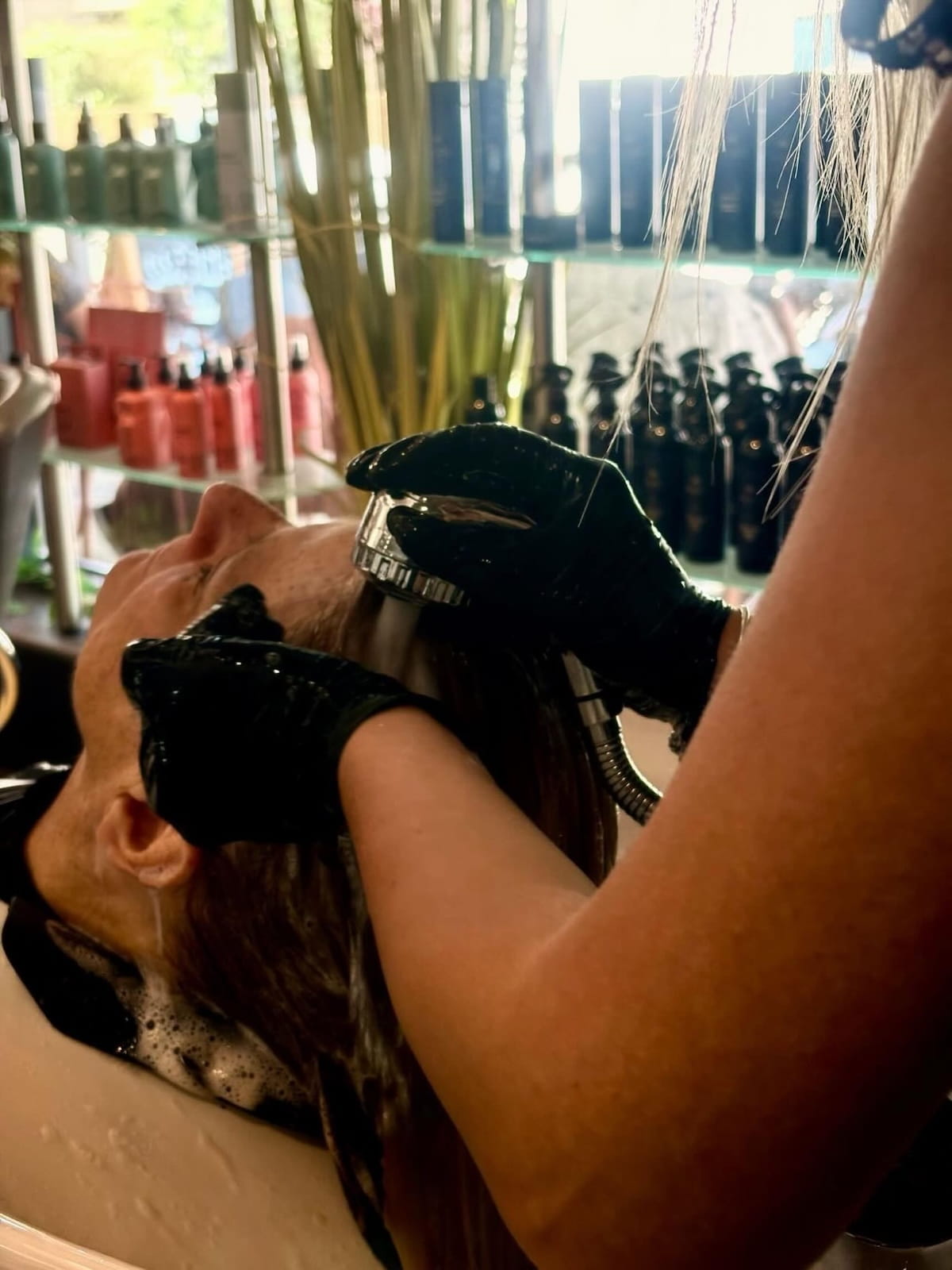
You’ve had your colour done. It looked beautiful for about a fortnight. Then the shine went flat, the blonde started pulling warm, and your hair began to feel that particular kind of rough, not dry exactly, more like there’s something sitting on it that won’t wash out.
Most people assume it’s the colour. Or their shampoo. Or that they’ve simply left it too long between appointments.
Very often, it’s the water.
If you live in Northampton, hard water is affecting your hair every single time you wash it, and it’s one of the most under-discussed reasons colour doesn’t last as long as it should. Here’s what’s actually going on, and what genuinely helps.
Is Northampton a hard water area?
Yes, and not mildly.
Northamptonshire ranks as one of the hardest water counties in England, sitting firmly in the “very hard” category with a hardness score of around 320. Only three English counties came out harder in a national comparison.
The reason is geology rather than anything to do with water treatment. Anglian Water, which supplies most of Northampton, draws heavily on groundwater that has passed through chalk and limestone. As it moves through that rock, the water picks up dissolved calcium and magnesium. Those minerals are completely harmless to drink, they’re the same ones that leave the white crust in your kettle.
The problem is that your hair is considerably more absorbent than a kettle.
You can check your own postcode on the Anglian Water website if you’d like the exact figure for your street. But for practical purposes: if you live in Northampton, assume your water is hard.
What hard water actually does to your hair
Every time you wash, those dissolved minerals come out of the water and deposit onto the hair shaft. One wash makes no difference. Two hundred washes a year is a different story.
Here’s how that shows up.
Your colour fades and shifts faster
Mineral deposit builds a fine, uneven film across the cuticle. That film scatters light instead of reflecting it, which is why colour that looked glossy in the salon can look dull and slightly flat within a couple of weeks, even though the pigment is still there.
Minerals also interfere with how colour sits in the hair, which is why tone drifts sooner than it should.
Blonde takes the worst of it
If you’re blonde, you already know this one. Lightened hair is more porous by definition, the cuticle has been opened to lift pigment out, so it absorbs and holds minerals far more readily than virgin hair.
Iron and copper in particular can leave a warm, sometimes slightly orange cast on cool blondes. That’s a large part of why brassiness returns faster in hard water areas than in soft ones, and why your toner never seems to last as long as you were told it would.
Hair starts to feel coated, rough, or oddly heavy
Mineral build-up sits on top of the hair rather than inside it. The result is a texture people describe as straw-like, or rough, or “like there’s product in it that won’t come out.” Combing gets harder. Blow-drying takes longer. Hair loses its natural movement.
Your products stop performing
This is the one that catches people out. Hard water reduces how well shampoo lathers and how well conditioner and treatments penetrate. So you buy a better shampoo, notice no difference, and reasonably conclude the shampoo isn’t very good.
It might be excellent. It’s just working against a coated surface.
One honest caveat: hard water does not cause hair loss, and any brand telling you otherwise is overselling. The genuine, well-understood effects are mineral deposit, colour longevity, shine, and feel. That’s more than enough to be worth addressing — but we’d rather be straight with you about where the evidence stops.
How to tell if hard water is affecting your hair
A few reliable signs:
- Colour looks noticeably duller within two to three weeks
- Blonde warms up or goes brassy faster than you’d expect
- Shampoo doesn’t lather the way it used to
- Hair feels rough or coated even straight after washing
- Your hair behaves completely differently on holiday, or when you stay somewhere with soft water
- Limescale on your kettle, taps and shower screen
That last one is the giveaway. Whatever your kettle looks like inside, your hair is dealing with the same water.
How to protect your hair from hard water at home
You can’t change your water supply. You can change what it leaves behind.
1. Use a chelating or clarifying shampoo, but not every wash.
A chelating shampoo binds to mineral deposits and lifts them off the hair. Used roughly every two to four weeks, it resets the surface so everything else works properly again. Used every wash, it will strip your colour. This is genuinely a case where more is not better, and it’s worth asking your stylist how often is right for your hair specifically.
2. Follow it with a proper conditioning or bond treatment.
Clarifying opens things up. Something nourishing straight afterwards is what makes the difference between “clean” and “clean and looking well.”
3. Rinse cooler than feels natural.
Hot water opens the cuticle and lets more mineral in. A cooler final rinse closes it and locks shine.
4. Consider a shower filter.
An in-line shower filter reduces some of the mineral content reaching your hair. They’re not miracle devices and they need replacing on schedule, but for anyone in a very hard water area with expensive blonde to protect, many people find them worth it.
5. Use professional products designed for the job.
This is the point where supermarket haircare genuinely falls short. Professional formulations are built to work in real conditions, including hard water, and the difference is most visible on coloured hair. It’s the single biggest reason we recommend what we do at the backwash.
What we can do in the salon
Some of this can only really be tackled properly with professional products and a pair of trained hands.
A detoxifying or mineral-removing treatment will strip built-up deposit far more thoroughly than home care can, and it’s often the right first step before a colour appointment rather than after one. If your last few colours haven’t taken evenly or haven’t lasted, mineral build-up is one of the first things worth ruling out.
A gloss or toning service restores the shine and corrects the warmth that hard water pulls through. It’s a short appointment and it’s frequently the difference between colour that lasts four weeks and colour that lasts eight.
And most usefully of all: your stylist can look at your hair and tell you whether this is actually your issue, or whether something else is going on. That conversation costs nothing and is the fastest route to an answer.
Need more info? Check out our most frequently asked questions.
The short version
Northampton’s water is hard, that’s not going to change, and it’s quietly working against your colour between every appointment. Once you know that, it stops being mysterious and starts being manageable, a clarifying step at the right interval, the right products, and a gloss when tone starts to drift.
If your colour hasn’t been behaving lately, mention it to your stylist next time you’re in. It takes thirty seconds to look at and it’s very often the answer.
MAJOR Hairdressing has salons at Abington Grove and Weston Favell, Northampton.